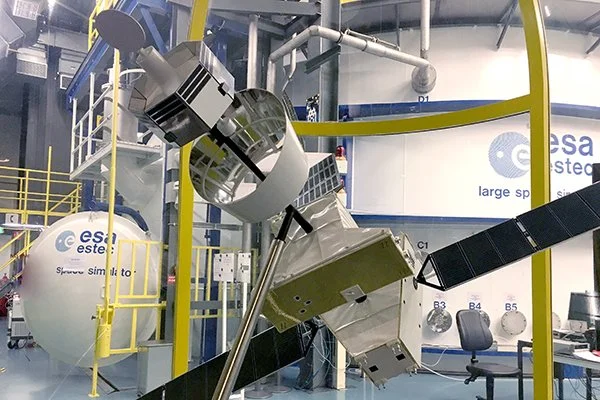
BepiColombo space craft model
One of the most meaningful collaborations of my artistic career began through my connection with the European Space Agency (ESA) during my work related to the Rosetta space mission. While visiting ESA in 2016 and engaging with scientists in the Netherlands, I had the opportunity to meet members of the BepiColombo mission team—a mission dedicated to exploring Mercury, the innermost planet of our solar system.
During my visit to ESA, I was invited into the clean room where the BepiColombo spacecraft was being assembled. Seeing a real spacecraft up close—carefully built layer by layer in an environment designed to protect it from even the smallest particles—was deeply fascinating. The spacecraft felt both fragile and incredibly powerful at the same time, a delicate object carrying enormous scientific ambition. Witnessing this process at such an early and tangible stage left a strong impression on me, blurring the boundary between engineering, science, and something profoundly poetic.
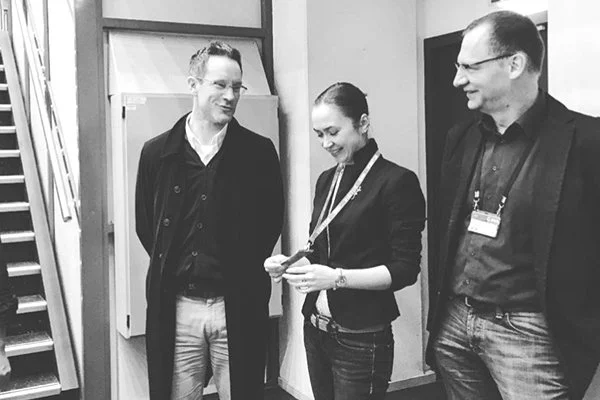
During the visit of the clean room: me (center),
Dr. Johannes J. Benkhoff (right)
I am especially grateful to Dr. Johannes J. Benkhoff, who made this visit possible. At the time, he was deeply involved in both missions—serving as a Co-Investigator on Rosetta instruments, and as the Project Scientist for the joint ESA–JAXA BepiColombo mission to Mercury. His invitation not only allowed me to witness the spacecraft during its construction, but also created a lasting connection between my artistic practice and space exploration, for which I remain sincerely thankful.
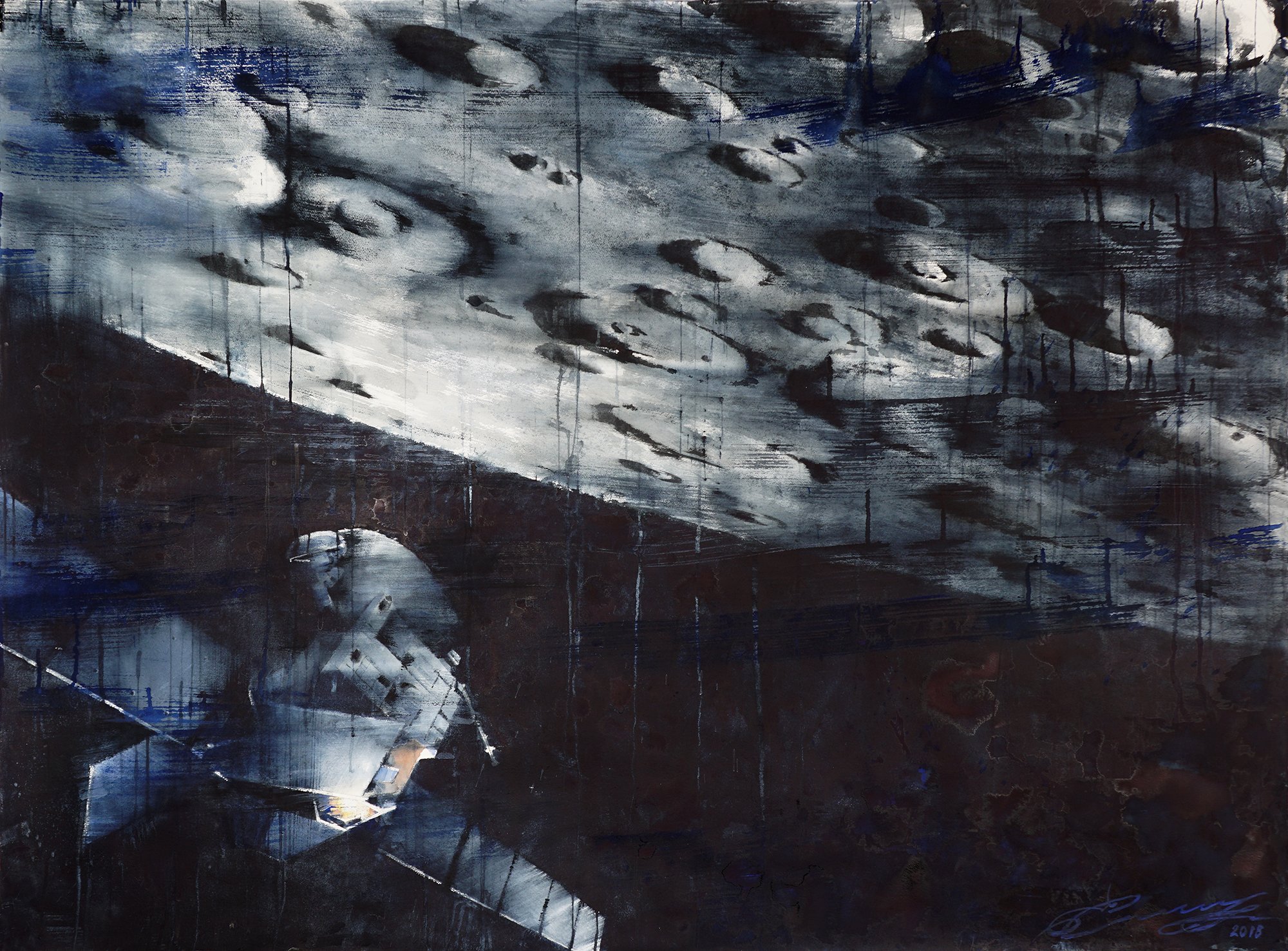
BepiColombo space craft approaching Mercury. Watercolor on paper. 52”x70”, 2018
BeppoColombo is a joint mission between ESA and JAXA (Japan Aerospace Exploration Agency), designed to study Mercury’s surface, magnetic field, interior structure, and its interaction with the Sun. Because Mercury lies so close to the Sun, reaching it is extremely complex. The mission relies on a long and carefully planned journey through the solar system, using multiple gravity-assist flybys to gradually slow the spacecraft down.
After its launch, I followed the mission closely. BepiColombo traveled past Earth, then performed flybys of Venus, using each planetary encounter to adjust its trajectory and energy. These stages are essential steps toward the final goal: entering orbit around Mercury—a planet that is both elusive and extreme, shaped by intense heat, radiation, and solar forces.
Even after returning home to the Pacific coast, I remained deeply connected to the mission. I often listened to online scientific conferences and briefings, many of which took place during daytime in Europe. For me, that meant tuning in late at night, following discussions about trajectories, instruments, and discoveries in the quiet hours while the rest of my surroundings slept. It was fun watching Venus on the early morning sky while scientists on my computer screen were discussing Venus flybys. Those moments felt intimate—an artist listening in on humanity’s collective effort to understand the universe.
My collaboration eventually extended to Japan, where I traveled to attend a scientific conference and meet Japanese researchers involved in the mission. I gave a talk about my artistic practice and its dialogue with space exploration, and I also had the opportunity to visit JAXA, Japan’s space agency. As part of this exchange, I created a painting inspired by the mission and presented it as a gift to the JAXA scientists, as a gesture of gratitude and shared curiosity.
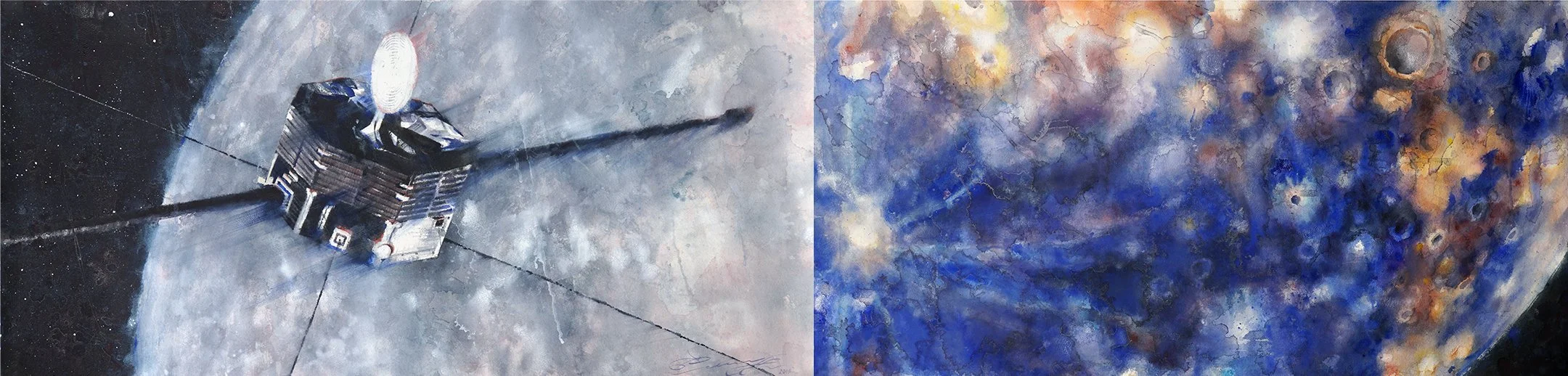
Mercury Magnetospheric Orbiter (MMO), JAXA (left), Mercury in spectral imaging (right)
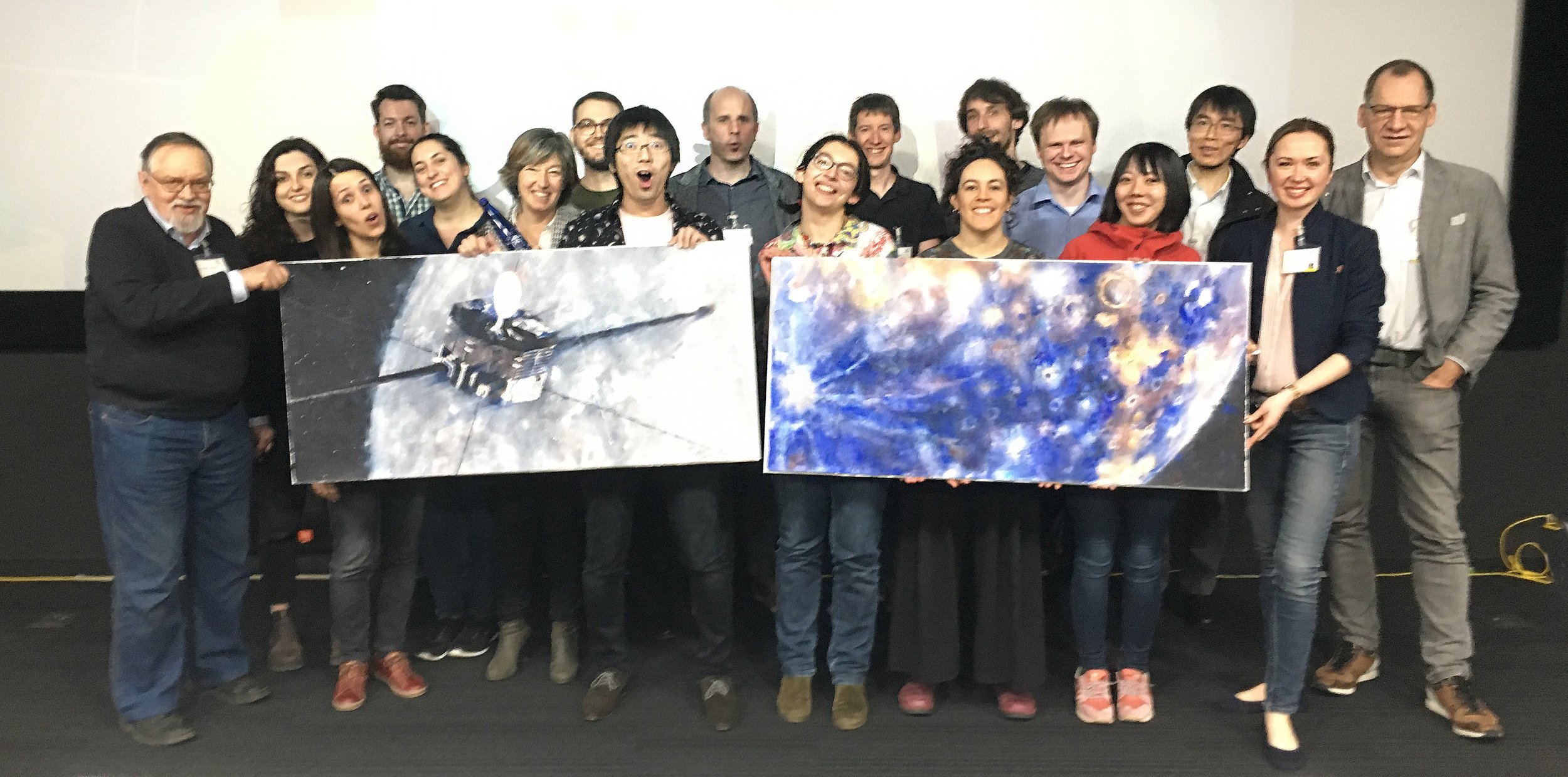
BepiColombo working team during a conference in Tokyo, 2019
These experiences reinforced my belief that art and space exploration are deeply connected. Both are driven by curiosity, patience, imagination, and a desire to reach beyond what is immediately visible. Collaborating with the scientists of the BepiColombo mission allowed me to witness not only a spacecraft’s journey to Mercury, but also the human dedication behind it—and to translate that sense of wonder into my own work.
As BepiColombo continues its journey toward Mercury, the mission has already begun to reveal the planet in unprecedented detail. During its flybys, the spacecraft has captured subtle variations in surface composition and temperature, hinting at Mercury’s complex geology and magnetic environment. These discoveries, particularly from the ESA Mercury Planetary Orbiter and JAXA’s Mio, deepen the story I witnessed firsthand in the clean room—the layers, the careful construction, the immense precision now translating into knowledge about a distant world. Looking ahead, the two orbiters will separate and enter Mercury’s orbit in late 2026, beginning coordinated studies of its surface, interior, exosphere, and magnetosphere.
For those interested in following BepiColombo’s discoveries, ESA provides public-friendly updates and images here: